Faulkner’s use of the stream of consciousness technique enhanced the telling of the Compson family’s tragic tale. The narrating (if steam of consciousness is considered “narrating”) of the family’s destruction is presented through multiple perspectives and through the broken flow of thoughts. The disjointed story telling mirrors the disjointed Compson family. Faulkner forces us to be literary detectives and piece together the fragments of the family puzzle. Faulkner keeps us engaged by planting clues in our scavenger hunt. Through the process of collecting ideas, deciphering clues, and completing the jigsaw puzzle that is The Sound and the Fury, we are given a unique perspective into the family’s demise.
Benjy’s steam of consciousness creates a broken path for the reader to follow. When I started reading the novel my own stream of consciousness kept connecting Benjy to Christopher Boone, the autistic child from The Curious Incident of the Dog in the Night Time. However, further into the novel I realized Benjy was much harder to understand than Boone. Perhaps because we are inside the mind of Benjy, meaning we experience his thoughts in real time--unlike with Chris Boone. Faulkner’s exploration of the human psyche’s leaping thoughts makes the novel more challenging and consequently more compelling. If the Compson family’s struggle were told as a conventional story, the effect would be completely different. Because we are inside Benjy’s mind, we feel his emotions and experience the story on a personal level—a level that could not be achieved through say an omniscient narrator.
A scene that really demonstrated this emotional connection was when Benjy wanted Caddy to wash herself to rid her of the deeds she’s committed (an allusion to Lady Macbeth of course). Benjy pushes Caddy into the bathroom, but instead of washing, Caddy cowers against the wall. She has just lost her virginity, and therefore cannot wash away this action like she had previously done. The violent scene is dramatic with flowing tears and yelling. Through Benjy’s perspective we see his pain as well as Caddy’s. Faulkner gives us enough of the scene to paint a picture in our mind of what happened. However, this picture is abstract—like splatters of a scene against a murky canvas. The rest of the painting is to be painted in later.
Quentin’s narration on June 2nd, 1910 is another great example of how the technique of steam of consciousness enhances the story. Our understanding of Quentin comes from memory fragments and his consciousness on the day of his suicide. Faulkner gives subtle, but later obvious hints, about Quentin’s strange actions. Quentin’s obsession with time, his packing of clothes, and his writing of letters-to-be-mailed-tomorrow are all clear signs that he has decided to commit suicide. Towards the end of this section, all marks of punctuation, grammatical rules, and even spelling are disregarded. This deterioration of logical sentence formation is indicative of Quentin’s state of mind: that of a suicidal man who no longer cares for trivial things or the rational of grammar.
Overall, Faulkner’s use of steam of consciousness may have been unconventional. However, it proves essential to the telling of the Compson’s tale. The coupling of unique perspectives, broken bits of memory, and interconnected thoughts create a fuzzy mental image of what exactly happened. While there are still two more sections to explore, the readers are well on their way to (hopefully) understanding the complete story. Faulkner keeps us attentive and engaged throughout this process.
(573)
Thursday, October 25, 2007

Friday, October 5, 2007
Invocation of the Muse
To Wilde, my Muse:

Why post a portrait of Oscar Wilde?
Here is my reasoning:
By posting this rather large image of Wilde, my blog will be infused with his enigmatic greatness. I’m hoping that Wilde’s portrait (like the picture of Dorian Gray) will have an opposite, but equal effect on my blog: Wilde's soul will be reflected in my blog. And if not, hopefully it just seasons my writing with a little Wilde spice.
Fun Wilde fact of the week: As the result of a famous trial, he suffered a dramatic downfall and was imprisoned for two years of hard labour after being convicted of the offence of gross indecency. (source Wiki)
Why am I not surprised?
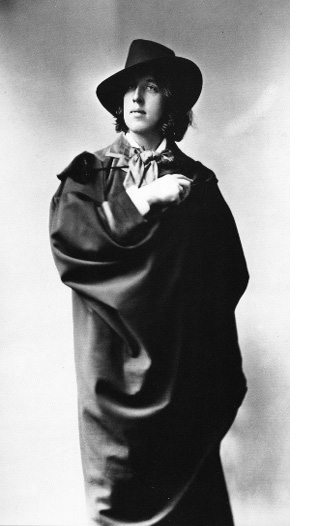
Why post a portrait of Oscar Wilde?
Here is my reasoning:
By posting this rather large image of Wilde, my blog will be infused with his enigmatic greatness. I’m hoping that Wilde’s portrait (like the picture of Dorian Gray) will have an opposite, but equal effect on my blog: Wilde's soul will be reflected in my blog. And if not, hopefully it just seasons my writing with a little Wilde spice.
Fun Wilde fact of the week: As the result of a famous trial, he suffered a dramatic downfall and was imprisoned for two years of hard labour after being convicted of the offence of gross indecency. (source Wiki)
Why am I not surprised?
"It is the spectator, and not life, that art really mirrors."

The Picture of Dorian Gray is one of the best novels I have ever read. Unfortunetly, I discovered that it is Oscar Wilde’s only novel. His epigrams and philosophical comments on life are fascinating. I can only imagine how a conversation with Wilde would have been. I imagine the chaos of Flail’s philosophy class nicely organized into beautiful prose. A hard task indeed.
Being an artist myself, I was intrigued most by the preface. Wilde defines art and the artist by telling us what art and who the artist is not. I actually had to reread the last line (“All art is quite useless.”) because I didn’t make the connection to the previous paragraph. Wilde says, “…The only excuse for making a useless thing is that one admires it intensely. All art is quite useless.” I was more comforted after I understood this statement. At first I didn’t understand the importance of the preface. But after reading most of the novel, some of Wilde’s statements really resonate through The Picture of Dorian Gray.
Wilde says, “It is the spectator, and not life, that art really mirrors.” Since the portrait is hidden in a secluded room, Dorian is the only man who can see the portrait changing. In the special case of Dorian, the art literally reflects the spectator’s soul. The premise of the story is that the soul of Dorian Gray is supernaturally emulated in Dorian’s portrait. And through the novel Gray’s sense of morality shrivels and deteriorates. While he remains flawlessly beautiful and angelic on the outside, Dorian’s soul is corrupted and ugly. But Dorian’s portrait does not simply become hideous. It expresses the wickedness of Dorian’s soul. Every ugly, immoral act is reflect in his eyes, his smile, and his face. It is one thing to be ugly on the surface, but another to be ugly within.
Basil Hallward’s masterpiece is the portrait of Dorian. In the beginning, Basil does not want the world to see this portrait because “there is too much of myself in the thing…too much of myself!” (13). Dorian also feels that the portrait is “part of myself” (26). Could it be that Basil’s intense admiration of Dorian actually allowed the artist to capture Gray’s soul in his artwork? Wilde says in the Preface, “Vice and virtue are to the artist materials for an art.” At first Dorian was the embodiment of innocence and virtue. These qualities first attracted Basil to Dorian. However, Basil’s friend Lord Henry Wotton infuses Dorian with the thought that beauty and youth are only ephemeral. The thought that one day he might be old and ugly consumed Dorian and disturbed him. In a moment of despair, Dorian screams, “…If it were I who was to be always young, and the picture that was to grow old! For that--for that--I would give everything…I would give my soul for that!” (25). He did.
My question is what was Wilde trying to convey through this exchange of souls? The portrait contradicts the theory that art and morality are disjointed. The theory, paraphrased, states that if art is intended to have a moral purpose, it is no longer art for art’s sake: It is propaganda for a certain belief. However, the portrait of Dorian Gray, is the reflection of his moral soul. (581)
I still have a lot of exploring to do with this novel. I am thinking about writing my essay on morality and art. Do you have any ideas for it Mr. Coon?
Thursday, September 27, 2007
Gray Scale
This week the stories we read transitioned from black and white to gray. Don’t worry, let me explain. They went from darkness and light in “A Clean, Well-Lighted Place”; to the contrast of black and white in “Battle Royal”; to complete monotone grayness—in the form of equality—in “Henry Bergeron”. The dichotomy of opposites is a powerful way to add dynamics and friction to a short story.
Ernest Hemingway’s “A Clean, Well-Lighted Place” is a story about the stages of life—especially old age. The story begins with a stark contrast of darkness and light. It begins with the image of “an old man who sat in the shadow of the leaves of a tree made against the electric light” (1). The aged man is in the shadow of death. His energy for life is depleted, and so he spends his days in the café drinking away his despair. Two waiters, one old and one young, give the readers two different perspectives on the old man’s situation. (Here is another contrast—old and young). The elder of the two sympathizes with the old man. He views the café as a place of refuge for the dejected senior. He stays late in the café “with all those who do not want to go to bed. With all those who need a light for the night” (70). While the younger waiter, who is more materialistic and immature, sarcastically wishes that the old man (who attempted suicide) “should have killed [himself] last week” (18). Although the older waiter is more in tune to the complexities of human emotion, there is another reason behind his empathy. He feels the same way about life as the old man. In his “nada” monologue, the old waiter reveals to us his disinterest in life. It is not only the old man who needs a light for the night, but also waiter himself.
This idea of “light for the night” has many possible meanings. The one that I concluded was a metaphor for death and the afterlife. Darkness has been and will always be connected to death, the great unknown. The old man’s despair and the old waiter’s pessimistic view of life both stem from their disinterest in life. The old waiter states (in reference to life), “It was all a nothing and a man was nothing too” (76). He goes on to recite the Lord’s Prayer, replacing key words with “nada”. It is here that the religious subtext of the story is displayed. When reading this short story I was reminded of a series of paintings by Thomas Cole. His series “The Voyage of Life” is an allegory of the four stages of man’s life: childhood, youth, manhood, and old age. An exerpt from Wikipedia best describes the four paintings
"In childhood, the infant glides from a dark cave into a rich, green landscape. As a youth, the boy takes control of the boat and aims for a shining castle in the sky. The last two pictures reverse the boat's direction. In manhood, the adult relies on prayer and religious faith to sustain him through rough waters and a threatening landscape. Finally, the man becomes old and the angel guides him to heaven across the waters of eternity." (http://en.wikipedia.org/wiki/The_Voyage_of_Life)
Because death is encroaching and the mystery of the afterlife is still well, a mystery, religion is the only way to make death more comfortable. It seems that both men are spiritually lost, and therefore uncomfortable with the possibility of their dismal afterlives. To conclude, the poetic rock band MUSE, in their song “Thoughts of a Dying Atheist”, sang, “Look through a faithless eye/ are you afraid to die? / It scares the hell out of me/ and the end is all I can see…”
In my discussion Ralph Ellison’s “Battle Royal” fits in the middle of my two themes: the dichotomy of black and white (and its various connotations) and that of equality. It is a story that speaks about racial tension as well as racial equality. The story is a struggle of a young black man battling a world dominated by white men. With this story I want to focus on a singular scene. After being battered, the young black man gives a speech. His mouth is being flooded with blood, when he utters the phrase “social responsibility” (69). He tries to speak, but chokes on his blood. He is forced to repeat this phrase and accidentally (or more likely a Freudian slip) he croaks “social…equality” (81). His swallowing the blood that runs through his veins is important. Through this act, he is symbolically swallowing part of himself, his people, his heritage, and therefore his pride. In a time of racial inequality, African Americans explored many different ways to elevate their social standings. Civil disobedience was a reaction to violent attacks from both blacks and whites. This story shows how the protagonist’s subordination may help him survive, but it does not help him win the war. And that racial, gender, and social equality sadly does not come without a price. To steal another line from MUSE, “Why can't we see / that when we bleed we bleed the same.”
Kurt Vonnegut creates a satirical contrast to America in “Henry Bergeron”. He takes us to a time when equality is the norm. In our future, the beneficially competitive atmosphere of our country is gone. Instead, the citizens have created the 211th, 212th, and 213th Amendments to ensure that “they were equal every which way” (1).With our competitive edge handicapped, our nation deteriorated. To steal a line from Darwin, natural selection works only if there is variation within a population. So in order to evolve there needs to be variability. Where there is no evolution, there is no progress. Of course, I am not advocating Social Darwinism. I mentioned this to point out that the laws of evolution no longer apply to this imaginary nation.
Vonnegut makes a strong statement through his satirical approach to the concept of equality: We need inequality. In America today, inequality gives us something to strive for. To take a lesson from the failed social experiment of Soviet Russia, equality creates complacency. In Vonnegut’s world in 2081, the strong were weighted down; the beautiful were masked; and the intelligent were prevented from thinking. Although “equality” is a political buzzword and a happy thought, its far-reaching side effects are often overlooked. If we all looked the same, it would be hard to tell us apart. If we all were the same age, we wouldn’t have the perspective of a child or the experience of the old. If we were all equal, we would have nothing to distinguish us and, most importantly, nothing to strive for.
So what is this week’s lesson, kids? Our differences make us more exciting. It really sounds like something we learnt in kindergarten. But the older I get, the more these basic lessons take on more complex meanings. (1,157)
P.S. Mr. Coon, you can click on the thumbnails to see the enlarged paintings. They're wonderful! Also, the formatting for the block quote didn't work...so I just put the quotation marks instead.


Monday, September 17, 2007
Revelations in the Pig Parlor

“Revelation” is the story of Mrs. Ruby Turpin’s self realization. Flannery O’Connor takes us on Mrs. Turpin’s journey from damnation to possible redemption. Mrs. Turpin represents the sin of pride. Her self-satisfaction and obnoxious sense of superiority are taken to the extreme and eventually crushed by her final, belittling revelation. Through a series of strange events in unexpected places, O’Connor evokes the maxim that God works in mysterious ways.
Ruby, the protagonist, prides herself on being above everyone else. Her superiority complex is most clearly displayed in the doctor’s waiting room. While the waiting room is not the typical place for a spiritual awakening, it is a good location that emphasizes the maxim above. In the room is a collection of people from different socio-economic backgrounds: most notably, Mrs. Turpin, Claud, a pleasant (well-to-do) lady, a fat teenager, named Mary Grace, reading a book entitled Human Development, “white-trash” woman, and for a moment, a black delivery boy. Ruby places the classes of people in her own hierarchy: on the bottom were most “colored people,” then white-trash, then home owners, and then property owners like herself and Claud. She would “dream they were all crammed in together in a box car, being ridden off to be put in a gas oven” (24). In the waiting room, her internal thoughts reflect her constant criticism of her surroundings and company. For example, in reference to the cleanliness of her pigs, she thinks that her pigs are “cleaner by far than that child right there…poor nasty little thing” (44).
Mrs. Turpin’s sarcastic, smug remarks are heard only by the story’s readers. Yet, we get the sense that Mary Grace can also hear Mrs. Turpin’s internal thoughts. Mary’s scowling, smoldering eyes intensify with the mounting pride of Mrs. Turpin. Ruby repetitively praises God for elevating her above so many others. Her judgmental thoughts, coupled with her racist, derogatory commentary make Mrs. Turpin very disagreeable. However, in her own eyes, God gave her a good disposition (101). Blinded by her pride, Mrs. Turpin does not realize her many faults. And therefore she continues her praising of God. At the climax of Mrs. Turpin’s exaltation, she exclaims, “When I think who all I could have been besides myself and what all I got, a little of everything, and a good disposition besides, I just feel like shouting…Oh thank you Jesus, Jesus, thank you!” (101). Right then, Mary Grace hurls Human Development at Mrs. Turpin’s inflated ego. Mrs. Turpin is saved by the violent actions of Mary Grace. Her name is no coincidence, considering that she is the (unlikely) messenger of God’s grace to Ruby. Mary spats, “Go back to hell where you came from, you old wart hog” (113). At that moment, Mary’s intense eyes burned because she knew that “her message had struck its target”—literally and metaphorically (113).
Even after her encounter with Grace, Mrs. Turpin does not immediately realize her sin of pride. She wondered why “she had been singled out for the message, though there was trash in the room to whom it might justly have been applied” (130). Mary’s words echoed in Mrs. Turpin’s mind and disturbed her. Her last resort to understand this message was to ask God Himself.
Mrs. Turpin’s challenging of God is her most consequential display of pride. Her evening of questioning and denial created a whirlwind of anger and frustration within her mind. Ruby marched down to the pig parlor with a “look of a woman going single-handed, weaponless, into battle” (172). She looked to the heavens and—just as Lucifer—confronted God. In her ultimate moment of rage she roared, “Who do you think you are?” (187). The echo returned to her “like an answer from beyond the wood” (188). As if God simultaneously answered her and questioned her, “Who do you think you are?” Mrs. Turpin was utterly dumbfounded, signifying her humbling revelation. Ruby’s narrow sense of place was destroyed in that moment; while her perception of her place among men and God was widened. Mrs. Turpin—just as her fellow swine, illuminated by the sunset—was enlightened by a deeper understanding.
In the pig parlor, another unlikely place for spiritual enlightenment, O’Connor stages the second peak of Mrs. Turpin’s journey. Ruby’s vision of a processional march to heaven reestablished the message in her revelation: she, just as everyone else, must earn her way into heaven’s gates. The order in which they came was the opposite of her hierarchy. First in line were companies of white-trash followed by black people in white robes. Last in the procession were the people like her, known for their “common sense and respectable behavior” (192). However, their shocked and altered faces meant that “their virtues were being burned away” (192). This scene is where Mrs. Turpin’s self-image is transformed. She is last in line, even after the people she looks down upon. Her realization gives us hope that redemption is possible, despite her many mistakes.
In the end, Ruby’s beatitude over comes her as she hears the chirping chorus of crickets as the “voices of the souls climbing upward into the starry field and shouting hallelujah” (193). Although Mrs. Turpin is not an immediately likeable character, her spiritual journey gives her an opportunity for change and betterment. She realizes that she is last in line to heaven. But as she stares “unblinkingly on what lay ahead” she is aware of the necessity for change. At the beginning of “Revelation”, Ruby Turpin is smug and arrogant. But by the end, her newfound humility is a sign of her spiritual growth and hope for her future. (930)
Discussion questions:
1. Do your impressions of Mrs. Turpin change throughout the course of the story?
2. What was your reaction to Mary Grace throwing her book at Mrs. Turpin’s head?
3. Do we believe that Mrs. Turpin is a changed woman?
Friday, September 14, 2007
Perspectives and Reader Response
Perspectives
All the presenters thus far have explored the topic of perspective. We all know that the same event can have numerous interpretations depending on who the speaker is. This week in class I got a chance to explore the various reasons why the authors chose the specific view points for their stories. For instance, how different would "Teenage Wasteland" have been had it been told through Daisy's eyes? The choice of perspective is a key factor in determining the atmosphere, opinions, and even events in a story. While different characters may be interconnected, each character has its own history and unique view of the world. "Teenage Wasteland" was of particular interest to me. I questioned why we the readers were not told of Donny's struggles through his eyes. Instead, we saw his deterioration and eventual disappearance through the struggle of his mother Daisy. Upon further thought, I realized that by understanding Daisy's point of view we in turn saw Donny's journey through a dirty lens. Many aspects of his psyche are not clear to us. We only have the views of Cal, his teachers, and Daisy to formulate our opinions on. Often in the case of misunderstood, lost teenagers, adults and outsiders do not fully understand what the child is going through. Anne Tyler's approach was more natural with its spikes of highs and extreme lows. As Piper stated, we are lifted by the glimpses of hope that Tyler lures us with. Only to be crushed in the end by a very tragic ending. By the end of the story, we are left with more questions than answers about Donny. And perhaps Tyler wanted to leave the case open for further inspection.
"A Rose for Emily" was told through the eyes of an anonymous town member. In this case, William Faulkner wanted us to embark on the journey with the unknowing townspeople and learn the haunting facts about Miss Emily Grierson as they did. We see her life as an outsider would have seen it. Once again, we cannot confirm the motives behind her actions. We can only speculate. What is also interesting is how Faulkner completely changes our view of Ms. Emily with the very last three paragraphs of the story. Here we learn of Ms. Emily's murdering of her love interest Homer Barron and the strange details of the room he was kept in. Our emotions naturally mirror the emotions of the townspeople, because it is the only way we see the story. Throughout the story I found myself thinking "poor Emily," if only this had happened and so and so had not left. While in truth, Ms. Emily had many problems that the citizens and we were not aware of. It showed me how easily the reader accepts the narrator's ideas. However, when I reread the story I was able to piece together the clues and see different sides of Miss Emily that were hidden underneath the townspeople's impressions.
Alice Walker's short story "Everyday Use" benefits from having Mama tell the story. Mama, a level-headed mother of two daughters directs us through the family conflict. We respect Mama for her realistic attitude and acceptance of her daughters, despite their differences. Mama says, "I am a large, big-boned woman with rough, man-working hands," and explains how her fantasies of appearing on TV include her being "a hundred pounds lighter" (5). I think the reader gains her trust at this point. We all have fantasies and dreams, but Mama tells it like it is. Her internal thoughts give us insight into her true feelings towards her daughters. For example, when their old house was burnt down, Mama wanted to ask Dee, "Why don't you do a dance around the ashes?" (10). Mama is able divulge enough information about Maggie and Dee while still retaining important facts and letting Dee and Maggie express them.
The Interpreter of Maladies
Today in class we discussed “The Interpreter of Maladies”. I could relate to this story because I’ve witnessed the difference between Indians and Indian Americans. I found myself disliking Mrs. Das. Her uncaring manner and lack of interest in her family really struck me as surprising. Her portrayal went against all the conventional depictions of mothers. However, I found her inner turmoil to be very interesting. She had a son with her husband’s business partner and kept it a secret from her current husband. We can see her pent up pressure when she releases it to Mr. Kapasi. She has the unrealistic expectation that Mr. Kapasi can solve her problem or give her some reassuring advice. However, Mr. Kapasi was more interested in the possibility of a relationship and not her trivial personal secret. However that interest slowly dies as he learns of Mrs. Das’s secret. Lauren explored the topic of Mrs. Das and Mr. Kapasi’s evolution and destruction of their brief relationship. (813)
Thursday, August 30, 2007
To Err is Human
To err is human. Although Homo sapiens prize themselves for being wise, logical creatures, humans have the universal trait of being flawed. It is the imperfections of an individual that makes him more human. The most intriguing characters in literature are not the “perfect” ones. Readers more often identify with a character whose defects mirror their own. For this reason, authors often show the complexity of human emotion through their characters’ flaws. Through his interpretation and display of human flaws and human emotions, Mark Haddon has captured two key elements of the delicate human psyche in his novel the curious incident of the dog in the night-time.
Christopher John Francis Boone is not the typical protagonist: he is an autistic savant. He struggles to understand anything past the basic set of human emotions (happiness, sadness, and anger): a task most people would find intuitive. And yet he is a mathematical mastermind at the age of fifteen. Christopher can only see the world through logic and the formulas he created to rationalize life’s unpredictability. The use of Christopher is a unique way to portray a fundamentally human trait by emphasizing the fact that Christopher does not have it: the ability to communicate and understand emotion.
While it is not fair to say that Christopher is flawed, his autism is a handicap. Communication is difficult for him unless it is purely logical. He learns social norms and guidelines from his teacher Siobhan. Christopher claims that he “finds people confusing” (Haddon 14). He explains to the readers in the beginning of his narrative that Siobhan drew for him a set of faces expressing different emotions. He was only able to understand sad and happy faces: no others (Haddon 3). Because he does not have certain emotions, he cannot understand them. Through Christopher’s struggle, one can deduce just how vital the communication of different emotions is between people.
The rational Christopher acts as a foil to his emotional father Ed Boone. Through Christopher’s investigation a darker history of Ed and his mother Judy Boone is revealed. The readers learn that Ed is very sensitive. He reacts strongly to stressful and complicated situations, usually in the form of anger, violence, or irrational actions. For example, when Christopher’s mother left him, Ed lied to his son for years, claiming that she had died of a heart attack at the age of 38. When Christopher learns of the lie, he looses all trust in father, causing him mental and physical pain. Some of the most moving parts of the novel are the scenes in which Ed tries to regain the trust of his son. Ed, a compassionate, caring father, epitomizes the most potent human trait: the ability to love.
Of course, Christopher also has many fundamentally human traits. Two of his most prominent are his curiosity and ability to dream. His desire to discover Wellington’s murderer was the catalyst for his amazing adventure. Christopher’s final words in the novel are, “And I know I can do this [become a scientist] because I went to London on my own, and because I solved the mystery of Who Killed Wellington? And I found my mother and I was brave and I wrote a book and that means I can do anything” (Haddon 221). One of the most fascinating aspects of humanity is our imagination and willingness to go beyond reality and into the realm of possibility. In reality, we are flawed. But there is always the prospect of change.
(580)
Subscribe to:
Posts (Atom)
